
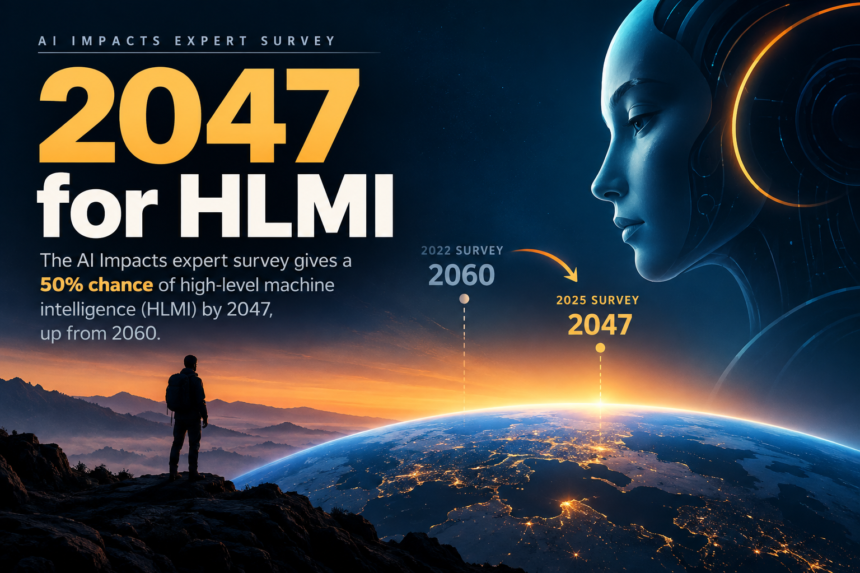
The AI Impacts expert survey gives a 50% chance of “high-level machine intelligence” (HLMI) by 2047, according to its aggregate forecast of 1,714 responses1, 2. That is 13 years earlier than the 2022 survey, which AI Impacts now restates as 20601, 2.
The 2047 figure is not a date for AGI in the loose sense, and it is not the only date the survey produced1, 2, 3, 4. This article uses only the 2022 AI Impacts survey and its 2023 successor1, 2, 3, 4.
What the 2023 survey is
The 2023 Expert Survey on Progress in AI was published as a preprint in January 20241, 2, 4. The survey received 2,778 responses from researchers who had published in six top AI venues1, 2, 4. The main survey group was run 15–24 October 2023, a 15% response rate1, 2, 4.
The authors say it ran after the launch of ChatGPT and GPT-44. That detail comes from the preprint alone4.
The 2022 survey drew 738 responses from authors at NeurIPS and ICML, a 17% response rate, according to AI Impacts1, 3.
What “HLMI” asks
Both surveys used the same wording for HLMI1, 3, 4. It means unaided machines accomplishing every task better and more cheaply than human workers1, 3, 4. Tasks where being human is intrinsically advantageous, such as jury membership, are ignored1, 3, 4.
The question is about feasibility, not adoption1, 3, 4. Respondents were also asked to assume human scientific activity continues without major negative disruption1, 3, 4.
Two dates, not one
The 2023 survey asked a second, occupation-based question: “full automation of labor” (FAOL), meaning all occupations being fully automatable1, 2. Its aggregate forecast gives a 50% chance by 2116, based on 774 responses, versus 2164 in 20221, 2.
The 2047 figure is therefore the task-based HLMI date, not the occupation-based one1, 2. The FAOL date is about 69 years later1, 2. Participants asked about FAOL tended to give significantly longer timelines than those asked about HLMI1, 2.
The table below sets the two surveys side by side on sample, wording and forecast years.
| Item | 2022 survey | 2023 survey | Source |
|---|---|---|---|
| Responses and venues | 738 responses, NeurIPS and ICML authors (17% response rate) | 2,778 responses, authors from six top AI venues (15% response rate); preprint | 1, 2, 3, 4 |
| HLMI definition (task-based) | Unaided machines doing every task better and more cheaply than human workers; feasibility, not adoption | Same wording | 1, 3, 4 |
| HLMI: 50% chance by | 2059 (37 years out); restated as 2060 in the 2023 wiki | 2047 (1,714 responses) | 1, 2, 3 |
| HLMI: 10% chance by | Not in the claims given | 2027 | 2, 4 |
| FAOL (all occupations fully automatable): 50% by | 2164 | 2116 (774 responses) | 1, 2 |
| Why 2047 is not the FAOL date | Different question | FAOL is about 69 years after the HLMI figure; those asked FAOL tended to give longer timelines | 1, 2 |
| Method | Not detailed in the claims given | Three year-probability pairs per person, gamma curve fitted, average curve; framing varied by half of respondents. Authors say framing can greatly influence answers | 1, 4 |
| Context and sample effect | Run before ChatGPT and GPT-4 launched is not stated; not in claims | Run 15–24 October 2023, after ChatGPT and GPT-4; authors say the wider sample did not appear to notably affect opinion | 1, 2, 4 |
| Task questions identical in both surveys (32) | Baseline | 21 moved earlier, 11 later; average 50th-percentile year 1.0 years earlier | 4 |
How the number is built
The headline year is not a simple median of what people typed1, 4. Each respondent gave three year-and-probability pairs, and a gamma distribution (a flexible curve for waiting-time data) was fitted to each respondent’s answers1, 4.
The preprint’s abstract also reports a 10% chance of HLMI by 2027 alongside the 50% chance by 2047, again conditional on science continuing undisrupted2, 4. That figure rests on the preprint abstract only2, 4.
Framing was varied. Half of respondents got a fixed-years question, asking for a probability by a given year1, 4. Half got a fixed-probabilities question, asking for a year at a given probability1, 4. The authors note that framing can greatly influence responses1, 4. They also note that AI researchers are experts in AI research, not in forecasting1, 4.
Why 2059 and 2060
The 2022 survey page reported a 50% chance of HLMI at 37 years out, which is 20591, 3. The 2023 material restates the 2022 figure as 20601, 3. The sources we have do not explain the one-year difference, and only AI Impacts material backs it1, 3.
AI Impacts calls the shift 13 years, which uses 2060 as the 2022 figure1, 2. The 2022 survey page itself gave 20591, 3. The sources do not state a shift measured against 20591, 3. Either way, the direction is the same: the 2023 forecast is earlier1, 2.
What changed between the surveys
The sample and the world both changed. The 2023 survey had around four times as many participants as 2022 because it expanded from two venues to six4. The authors say this did not appear to have a notable effect on opinion4. That is their own assessment, and the preprint is the only source we have for it4.
The task-level results suggest a smaller shift than the headline1, 2, 4. Across the 32 task questions identical in 2022 and 2023, the aggregate prediction moved earlier for 21 and later for 114. On average the 50th-percentile year shifted 1.0 years earlier4. This also comes from the preprint alone4.
The claims we hold do not explain why the HLMI date moved so much further than the typical task date, nor why researchers revised their views1, 2, 4.
How far to trust the 2047 figure
- It is a forecast. The aggregate projects a 50% chance of high-level machine intelligence by 20471, 2. It is not a prediction that machines will do every task by then1, 2, 3, 4.
- It is sensitive to wording. The same survey gives a date about 69 years later when asked about occupations instead of tasks1, 2.
- It is sensitive to framing. The authors say the way a question is posed can greatly influence answers1, 4.
- It reflects expertise in AI, not forecasting. The authors say so themselves1, 4.
- The comparison across years is imperfect. The venues, the sample size and the 2022 baseline year (2059 or 2060) all differ or are unclear1, 3, 4.
The most defensible reading is narrow. Among published AI researchers surveyed in October 2023, the aggregate forecast for a task-based, cost-conditional milestone was 2047, earlier than in 20221, 2, 3, 4.
This article was researched and drafted with the help of AI tools, then fact-checked against its sources and edited by a human before publication. Every source is linked below. If you spot an error, please tell us and we will correct it.
Sources
- 2023 Expert Survey on Progress in AI [AI Impacts Wiki] — wiki.aiimpacts.org, accessed 2026-10-03
- [2401.02843] Thousands of AI Authors on the Future of AI — arxiv.org (preprint, not peer reviewed), accessed 2026-10-03
- 2022 Expert Survey on Progress in AI – AI Impacts — aiimpacts.org, accessed 2026-10-03
- Thousands of AI Authors on the Future of AI — arxiv.org (preprint, not peer reviewed), accessed 2026-10-03